
Project title
COMBINED LIVER AND SPLEEN ELASTOMETRY AND METABOLOMIC PROFILING FOR THE NONINVASIVE DIAGNOSTIC AND PROGNOSTIC ASSESSMENT OF SEVERE ALCOHOLIC HEPATITIS. Project Acronym ALCOLISPELOMICS
Source of funding
A grant of the Romanian National Authority for Scientific Research and Innovation, CNCS – UEFISCDI.
Project code
PN-II-RU-TE-2014-4-0356
Contract number
371/01.10.2015
Project director
Horia Ștefănescu MD, PhD
Scientific Researcher
E-mail: horia.stefanescu@irgh.ro
Research Team
-
Horia Ștefănescu
-
Bogdan Procopeț
-
Petra Fischer
-
Ioana Rusu
-
Alina Habic
-
Camelia Coadă
-
Adelina Horhat
Project description
Abstract
Alcoholic liver disease is a major problem worldwide and in Romania, that can lead to advanced fibrosis and cirrhosis. Alcoholic steatohepatitis (ASH) is an acute condition that mimics advanced cirrhosis and may lead to liver failure. Therefore, it is important to differentiate ASH from underlying liver cirrhosis, but current gold standards are invasive. A reliable method to predict treatment response is also needed. Several proinflammatory cytokines and a possible genetic predisposition are suspected for ASH. Combined liver and spleen stiffness measurement (LSM/SSM) was associated with advanced cirrhosis. The aim of the project is to identify and validate a panel of noninvasive markers (LSM/SSM, a specific phenotype and metabolomic profile –MP) for an accurate diagnosis and prognostic assessment of patients with severe ASH, focusing on (a) differential diagnosis with decompensated cirrhosis; (b) 90-day survival prediction; (c) short-term complications prediction; (d) identifying changes in LSM/SSM/MP after 7 days of therapy that may predict the outcome. We designed a prospective study to enrol 108 consecutive patients with ASH. LSM/SSM/MP, determination of adiponectin, TNFα and LPS will be carried out at inclusion and at day7, and PNPLA3 polymorphism. All patients will also undergone HVPG measurement and transjugular liver biopsy as reference gold standards.
Objectives
Our aim is to identify and validate a panel of noninvasive markers for an accurate positive diagnosis and for prognostic assessment of patients with severe alcoholic hepatitis, more specific:
-
to validate the combined liver and spleen stiffness measurement as a diagnostic, prognostic and monitoring method for patients with severe ASH, focusing on (a) differential diagnosis with decompensated cirrhosis; (b) 90-day survival prediction; (c) shortterm complications prediction; (d) identifying changes in LSM and/or SSM after 7 days of corticoid treatment that may correlate with treatment response;
-
to identify and validate a specific metabolomic profile of ASH patients to be used for (a) positive diagnosis of ASH as well as for differential diagnosis with decompensated cirrhosis; (b) 90-day survival prediction; (c) short-term complications prediction; (d) identifying changes at 7 days of corticotherapy that may correlate with treatment response;
-
to identify a certain phenotype of patients with alcoholic liver disease – combining PNPLA3 polymorphism, low adiponectin and high TNF-alpha and LPS levels – that may be suggestive for the development of liver cirrhosis.
Expected results
Achieving a multimodal non-invasive diagnostic and prognostic approach for patients with alcohol liver disease. Reaching this result would have an impact on several levels:
-
it would offer a valid diagnostic method and a powerful risk stratification and prognosis tool;
-
validation of this approach would open the path for future collaborative clinical studies, even for evaluation of therapeutic efficiency of new drugs;
-
the project will try to implement an evidence-based state-of-the-art approach for patients with chronic liver diseases, according with European guidelines. The project will contribute to the establishment of a Liver Hemodynamic Laboratory for routine HVPG measurements and TJLB. It would also try to establish a referral centre for alcoholic liver diseases.
Plan of project realization
The above schedule for data gathering will permit the following analysis to be performed during the project execution:
-
Evaluate the applicability of LSM/SSM by different methods in patients with AH;
-
Confirm LSM/SSM/metabolomic profile (MP) as potential biomarkers of severity in AH;
-
Evaluate whether LSM/SSM/MP is a prognostic marker in AH;
-
Evaluate whether changes in LSM/SSM/MP might be used as early predictors of response to steroid therapy (assessed by Lille score performed at 7 days). Compare LSM/SSM/MP changes in patients with favourable Lille score at 7 days (<0.45) vs. those with non- favourable score (>0.45), after 3 and 7 days of treatment
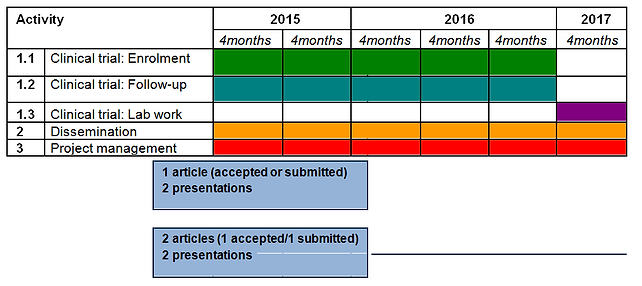
In terms of research management, the project may be subdivided into the following activities and subactivities (Gantt chart).
Activities 1 and 2 represent the scientific core of the project and are closely interconnected. The milestones and also the deliverables (scientific works of the project team) are prevised for months 20 and 24.
Activity 3 implies the following specific actions: obtaining the ethical committee‡ approval, human resources management, procurement of the supplies needed, subcontracting of some activities and risk management. The following chart summarizes the risk assessment and the contingency plan.
Publications
1. Lyso-Phosphatidylcholine: A Potential Metabolomic Biomarker for Alcoholic Liver Disease?
Stefanescu H, Suciu A, Romanciuc F, Crisan D, Procopet B, Radu C, Tantau M, Socaciu C, Grigorescu M. Hepatology. 2016 Aug;64(2):678-9. doi: 10.1002/hep.28630.
2. Lysophosphatidylcholine: a potential metabolomic biomarker for alcoholic liver disease.
Alina Suciu, Adelina Horhat, Anca Bugariu, Camelia Coadă, Crina Grigoraş, Dana Crişan, Bogdan Procopeţ, Marcel Tanţău, Carmen Socaciu, Mircea Grigorescu, Horia Ştefănescu. J Gastrointest Liver Dis 2016; 25(suppl 2):55-56.
Oral Presentations
1. Combined Liver and Spleen Elastometry for the prediction of response to therapy
in Severe Alcoholic Hepatitis - Horia Ştefănescu - 4th UpDate in Hepatology Course, Bucharest, 6-7.04.2017
2. Low Lysophosphatidylcholine levels may predict Severe Alcoholic Hepatitis - Petra Fischer, Corina Hebristean, Adelina Horhat, Crina Grigoras, Bogdan Procopet, Marcel Tantau, Carmen Socaciu, Horia Stefanescu - Al XXXVII-lea Congres Naţional de Gastroenterologie, Hepatologie şi Endoscopie Digestivă, 22-24 Iunie 2017, Bucureşti (Awarded 1st prize)
Posters
1. Low Lysophosphatidylcholine levels may predict severe alcoholic hepatitis - Petra Fischer, Corina Hebristean, Adelina Horhat, Crina Grigoras, Bogdan Procopet, Marcel Tantau, Carmen Socaciu, Horia Stefanescu - 25th UEGW Week, Barcelona 28.10-1.11.2017
2. Low Lysophosphatidylcholine Levels may Predict Severe Alcoholic Hepatitis - Petra Fischer, Corina Hebristean, Adelina Horhat, Crina Grigoras, Anca Bugariu, Bogdan Procopet, Marcel Tantau, Carmen Socaciu, Horia Stefanescu - 4th UpDate in Hepatology Course, Bucharest, 6-7.04.2017